Arrow's Guide to Running Fandom Events
After reading Agnes's guide to participating in fandom events, I figured that, well, as a frequent event mod, I could write something similar for running events.
And then it turned into a 10,000-word manual. But I digress.
My qualifications for writing this: I've been moderating fandom events since 2012, most recently having run 2 prompt fests in 2025, for a total of 15 events so far. I've hosted prompt fests, exchanges, big bangs, and kinkmemes, while playing side roles in a handful of other types of events. So after over a decade of doing this, I've inherited some experience—and, of course, some opinions.
This guide will walk you through my thought process, different types of common fandom events, logistical options and insights, and addendums.
Scroll down to get started ↓
Moderation
Before we get into the technical weeds, let's talk about why fandom events are a thing, and why you might choose to moderate one in the first place.
So:
What's the point of fandom events?
Fandom is built on community and creativity. Without people, there would be no fandom and no creative works. More often than not, without our relationships with each other, fewer works would exist, and fandom becomes smaller and less impactful.
Events within fandom inherently aim to encourage at least one of three things, by virtue of existing:
- more participation from more people
- more fanworks from more people
- more relationships between more people
As you can see, fandom events are about people. So of course there's going to be drama, wank, and disagreements—but there's also going to be generosity, creativity, and incredibly meaningful relationships. Interpersonal consequences are dependent on the people and environment in question, but ultimately events cannot exist without interested participants. Therefore, as a mod, your priority should be the people.
Note that this does not mean moderators are expected to abide by participant preferences or cater to demands. Rather, when one approaches the idea of running a fandom event, they should focus on maximizing participant results in terms of their goal. The primary role for moderators is to be a conduit between the event, its participants, and the audience.
Anyone can be a mod, but...
To take on the role of a moderator is to understand not only the technical responsibility of project management, but also the social responsibility for who will partake in your event, and how it will impact those outside of it. Moderating is a thankless task if you don't have the constitution for it, but it can be incredibly rewarding if you're prepared for all the ups and downs. Participants will drop out; people will get snarky; and if you're lucky, Murphy's Law will hit you maybe only once or twice.
Still, it's not inaccessible. I think anyone can be a mod, but I don't think everyone can mod well. When something goes wrong, not all mods know how to think on their feet, because a lot of times they don't have a clear end in mind. That'll mess up anyone's decision making: if you don't have a destination, it's harder to know how to get back on track.
I've had my fair share of mod screw-ups, so I'm not saying you have to do it perfectly or make correct decisions all the time. But when you voluntarily take on such a technical and social responsibility, you need to know what your priorities are: a community through the event, participants through the works they make, and your goal through moderating in the first place.
And it is gratifying—when participants talk about how much fun they had, when you have a collection of cool works, when people are asking you if you'll run the event again. But you can only get there by treating people well, knowing your own limits, and holding yourself accountable to a role you willingly took on. And in order to succeed, you should know what you want to achieve and how to achieve it through your event.
Event Goals
So this brings us to ask ourselves: What is our event goal?
Different types of events produce different results. If we have a goal in mind, we'll have a higher chance of success with an appropriate event type. Goals are tied to the points I listed earlier, but let's expand more specifically what events can do.
First, we'll consider balancing two critical factors when it comes to fan participation:
- Pressure - When people are pressured, whether by deadline and/or specific assignments, they are more inclined to produce works and be satisfied with results, especially when it comes to experimentation and quality. This isn't definitive, of course—but diamonds and all. And for participants, a good experience under pressure tends to motivate potential interest in future events.
- Freedom - People still want their freedom to create what they want, do what they want, and drop out and participate again. Penalties may understandably exist, but to host an event is to make it attractive for people to want to participate in the first place. Freedom in scope, length, creativity, or deadlines are all things participants take into consideration before they sign up.
Too much pressure may sacrifice freedom; too much freedom may not stimulate enough enthusiasm that pressure allows. Because fandom is about enthusiasm, both are critical to think about in the experience you want participants to have.
Freedom and pressure also apply to you as the moderator. As a mod, you may change the rules and schedule whenever you want. However, fans do expect all schedules and guidelines to be somewhat set in stone, so you should establish limitations for yourself as well.
Once you have an idea for how you'd like pressure/freedom to be weighted, you'll have a better idea of your desired end result and how you can get there. Your goals will likely look toward:
- Fanwork output numbers
- Participation numbers
- Overall community through forged relationships
Generally, you will want participants and works, and the right kind of participants to create the right type of works for your event. So it's good to have a goal in mind.
Event Scope
Another thing you'll need to consider is the scope of your goal. This is the subject by which you'll target both creators and audiences of your event.
Your scope might be:
- Multi-Fandom - To attract more participants and more diverse fandom results.
Good for general accessibility, including non-participants. - Fandom - To produce more fanworks in your fandom regardless of pairing, character, or content.
Great for smaller or newer fandoms, or fandoms with a lot of diverse sub-interests. - Pairing or Character(s) - To produce more fanworks featuring a particular pairing or character(s).
Great for fans who only like certain pairings or characters, regardless of popularity.
Good for forging relationships between similar-minded fans. - Rarity - Combined with one of the above. To produce more fanworks within a scope of a certain level of rarity.
Usually smaller/lesser-known, though events centering popular ships/characters are just as viable.
Good for more niche content without the scope being too narrow.
You can add tropes, genres, or ratings into your scope if you'd only like specific types of fanworks produced.
You might be interested in providing a specific prompt or category of prompts for your event. Works may also be expected to be crossovers, remixes, or only a certain type of medium (fanfiction, fanart).
If fans are not interested in the scope, then they won't be interested in signing up, regardless of your event type or guidelines. The event scope will ultimately attract fans the most; everything else is secondary.
One of the reasons Yuletide is such a popular event is because it's multi-fandom (so anyone can join), it's a gift exchange, and it focuses on small fandoms. Pretty much everyone has a small fandom, and new types of entertainment/fandoms are coming out nearly every day. Yuletide will likely operate until the heat death of the universe, because the nature of the event guarantees consistent interest over time.
Event Name
The name of your event should not be complicated. In approximate order, it should indicate your event's:
- Scope (fandom, pairing, rarity, etc.)
- Anything unique, such as when it takes place or what mediums are permitted.
- Type (exchange, fest, big bang, etc.)
The name of your event is the first impression fans will have of it, whether as a potential participant or audience member. If there are specific content limitations for your event, it would be best to indicate it in the name. For example: Wangxian CNC Big Bang, Supernatural SFW Fic Fest, K-Pop Valentine's Day Femslash Exchange, and so on.
Additionally, I recommend having a punchy shorthand or abbreviation for your event name, to make it memorable for fans and for the event collection/social media links.
If your event's name does not align with its content or purpose, participants may be confused and wanky as a result. Be sure that the event name is clear, concise, and accurate, as it will determine who may be interested in your event.
Event Types
Now, let's get into some of the most common types of fandom events around. If you've heard of BFE (Bangs, Fests, and Exchanges) you can probably guess the three big ones. I'll get into most others.
- Gift Exchanges
- Prompt Fests
- Big Bangs
- Zines
- Kinkmemes
- Stocking Exchanges
- Fanweeks
- Team Competitions
- Auctions and Raffles
Each event type has operational suggestions based on my personal experiences and observations. But you're free to do whatever you want—like the rest of this page, these are suggestions, not hard rules.
All events with schedules may allow submissions after the deadline.
Note: I did not include Bingos because of drastic logistical differences compared to the rest of this list.
Gift Exchanges
An exchange or gift exchange is an event where fans create works for each other based on administered assignment. This is the most popular type of event, because fans love creating as much as they love receiving.
(Gift exchanges are also my favorite.)
AO3 has a matching system for assignments, though it isn't perfect. I highly recommend using a blend of AO3's matching system and hand-matching with a spreadsheet.
Exchanges typically allow participants to provide a Dear Creator Letter to better articulate their requests and preferences, particularly if they don't have specific prompts in mind. Participants should always list DNWs (Do Not Wants) in their requests for creators to abide by.
Whatever else is required for assignments is up to you, depending on your scope. Many multi-fandom and fandom events operate under the optional details are optional principle, as in prompt details and preferences do not have to be followed as long as submissions match the requested fandom(s) and pairing(s). Many fans are kind, though, and like making works specifically tailored to their recipients.
Check out the FAQ at the end for more information on hosting gift exchanges on AO3.
- Options: Highly recommended: Anonymous Round, Public Prompts/Treats, & Tag Nominations.
You may also consider Staggered Reveals. - Evaluation: High pressure and low freedom, due to assignment and deadline.
- Good if your goal is: To simultaneously produce more works and more fan participation in your scope, with a frequent side effect of community bonding.
Prompt Fests
A prompt fest is an event in two creative stages:
- First, participants request prompts.
- Then, participants claim prompts to fill.
More often than not, requesters are not required to claim prompts, and vice versa. Do not expect all prompts to be claimed; this event is like a kinkmeme with a deadline.
Prompters are allowed to provide many prompts, but claimants can only be assigned to one, so most prompts may not be filled. Prompts are also expected to be unique, or at least dissimilar enough from each other. This is to diversify work output.
Each prompt should have a descriptive title and a limited number of claims before it is no longer available for claiming, so more prompts can get more love. This is best done on a unified masterlist of all prompts, like a spreadsheet, so you can indicate how many claims are left per prompt. Limiting the number of claims per prompt also guarantees more variety in the final works.
When claiming, claimants should list their top 3-5 prompts as there will inevitably be a delay between their claiming and you confirming it and updating your prompt masterlist. For example, if two claimants list the same 1 prompt before you are able to update the list after the first claim, you will have to let the second claimant know and make them pick another one. If you have their top 3 prompts, then you can skip a few steps to get the same (or even better) results.
You may allow participants to double up on prompts as a Treat only if they have finished their first unique assignment.
Participants who both request and claim may be interested in claiming their own prompt. This is typically allowed.
A standard fest does not have a prompting period and therefore no expected signup/assignment. It is still a challenge in being a closed schedule of submitting works by a deadline to be published during reveals.
- Options: Highly recommended: Anonymous Round, Public Prompts/Treats, & Tag Nominations.
You may also consider Staggered Reveals. - Evaluation: Low pressure due to voluntary roles, medium freedom due to schedule & prompts.
- Good if your goal is: To produce more works for your scope, with a side effect of more diverse participation.
Bangs
A bang is an event where writers write a fic, and about halfway through the event, each fic's metadata/info gets privately shared to signed up artists to claim. This is to create a collection of collaborative fic-and-art pieces.
Art may constitute as traditional/digital illustrations, graphics, fanmixes, fanvids, or other media. This part is up to you.
You may have heard of:
- Big Bangs, where the end result is similar to a novel with artwork covers.
Across fandoms, a big bang minimum word count may be 10k, 30k, 50k, or whatever mods find most doable. - Reverse Bangs, where the writer and artist's roles are switched.
These typically have a word count maximum to keep primary focus on the art.
Bangs are defined by size determined by fanfiction word count, such as mini-bangs.
Due to the work that goes into writing, (big) bangs may also consider assigning beta readers, in addition to artists.
Writers may sign up with an existing artist and/or beta reader and/or collaborative writer, and use the bang challenge as motivation for them to actually work on their fic. This is typically allowed, as the showcase of ambitious projects tends to take priority over assigning new collaborators.
In the past, cheerleaders were assigned to help boost each project's morale, though that may have become a depreciated practice. Still, if bang projects are to be private endeavors, I would recommend at least considering it.
- Options: Work Length, Staggered Reveals
- Evaluation: Medium pressure and freedom for writers due to deadline and any work guidelines, high pressure and low freedom for artists, though they may assist writers with story development.
- Good if your goal is: To produce more ambitious works and collaborations (writer-artist relationships) in your scope, with a side effect of more participation.
Zines
A zine, short for "magazine," is a collection of works compiled into one project for audience distribution, whether digital or print. Digital zines are usually available for free; print zines tend to require payment from fans.
Before the internet—and before we had exchanges/fests—we had zines for fic. Nowadays, zines tend to be exclusive collaborations with a higher focus on art.
If payment is required to access your zine, be confident in your financial responsibilities, particularly when it comes to pricing and production costs. Establish transparent refund policies in case anything falls through. And don't use personal Paypal accounts to handle zine funds.
See Zine There, Done That for more on zine management.
- Options: Invitation-only, Platforms for purchasing print zines
- Evaluation: High pressure depending on work length and deadlines, medium freedom depending on scope
- Good if your goal is: Quality, or the production of the zine itself, along with any merch
Kinkmemes
A kinkmeme is an event consisting of mini request-fill periods per prompt, and no deadline. They always allow anonymity for prompters and creators. Doing so permits more works regardless of attribution.
Essentially, a kinkmeme is an ongoing prompt fest with no specified claiming period, no claim/fill overlap rules, and no due date. However, they may have separate rounds designated by time period, for prompt management.
Prompts should have a descriptive title for readability, and any additional preferences, specifications, or wishes in the prompt description. Prompts can range from being incredibly vague (e.g. mermaid AU) to incredibly descriptive (e.g. a synopsis with every plot beat.) Fills do not necessarily have to follow the prompt exactly, as long as they are clearly inspired by it.
You may consider organizing all prompts on a Pinboard (paid accounts only) for easier navigation. Kinkmeme prompts on Pinboard or other bookmarking services tend to be tagged by characters, pairings, tropes, kinks, top/bottom preferences, and other user-relevant interests.
- Options: Platform
Best hosted on platforms that support threaded comments (LJ, Dreamwidth).
Kinkmemes can also be hosted on AO3 as a Prompt Meme, though due to AO3's interface limits, users are limited to requesting 50 prompts per collection. New rounds can be in new collections, with a parent collection for the kinkmeme as a whole. See the MDZS Kink Meme as an example. - Evaluation: Low pressure, high freedom (no deadline)
- Good if your goal is: To produce more (diverse) fic and more participation from anonymized fan creators; and if you don't want to manage people that closely.
Stocking Exchanges
A stocking exchange is an event where requesters submit wishlists of prompts and/or preferences along with DNWs/squicks. Wishlists then get posted publicly for creators to secretly fill their wishes. All fills get revealed after a deadline.
This is, in a way, a low-pressure combination of an exchange and a prompt fest.
Participants may be both requesters (wish-makers) and creators (wish-fillers), or choose to be one or the other. Typically, these roles are at-will to maximize participation.
As stocking exchanges are best and typically hosted on Dreamwidth or LiveJournal, wishlists can be submitted as comments on a signup post. Each wishlist will then get its own post, posted by the mod, with fills as screened comments prior to reveals. Works can be crossposted to AO3 and other sites after the event.
- Options: Platform (Dreamwidth or LiveJournal)
- Evaluation: Low pressure as wishing/filling is voluntary, medium freedom due to prompt/wishlist limitations
- Good if your goal is: More participation and community bonding, with a side effect of more works.
Fanweeks
A fanweek is a week (or designated time period) where each day has a specific prompt. The list of event prompts per day is revealed at least a month beforehand to allow participants time to create.
During the event period, works fulfilling prompts on each designated day are shared via reblog on the event account. Posts should be findable with a designated tag for the event, such as #HannigramWeek2025. Fanfiction may be submitted to the fanweek's respective AO3 collection.
Fanweeks typically do not have a signup period or check-in, as participation is at-will.
Because of this, I encourage prompts to aim for universality, erring more loose than restrictive. Check out oisuga-week's past prompts for some examples.
Fanweeks tend to be one of the most iterative events due to their temporal nature. You may consider running a fanweek at least twice; I would suggest a 6-month gap between week-long rounds.
- Options: Event Period (a month, two weeks, weekends, etc.), Platform (micro-blogging sites & AO3)
- Evaluation: Medium pressure due to prompt deadlines, high freedom due to voluntary participation and prompt interpretation
- Good if your goal is: To produce more fic and art equally, and if you don't want to manage people.
Team Competitions
A team competition is an event where participants get sorted into teams (whether self-selected or assigned) and compete for points through the creation of works. This requires high participant management, and is usually best managed by a mod team instead of a single person.
Team competitions are best suited for multi-fandom or fandoms with large diverse scopes. They may consist of multiple rounds of differently measured challenges, to tally up points.
The goal of team competitions is to win—for bragging rights and good fun! Custom graphics/banners for the event are typically awarded to the winners.
There is not a lot of precedence for team competitions in fandom, so feel free to come up with your own ruleset.
- Options: A lot. See kpop_olymfics, HSWC, and the Sports Anime Shipping Olympics as examples.
- Evaluation: High pressure and low freedom, due to metrics for works to be evaluated on the same level
- Good if your goal is: Participation, community-bonding, and high-quality works driven by competition.
Requires consistent moderator to participant communication and healthy, well-balanced teams. This is by far the most intensive type of event with (hopefully) equally intensive results.
Auctions and Raffles
Auctions/raffles are events where creators sign up to create for some specific fandoms/ships, and then get auctioned off to other fans to create for the highest bidder's matching fandom/ship and later provided supplementary prompt. Creators may sign up with personal content limitations.
These tend to be done as charity events, where bids are real-life money. Donations should be made prior to work creation and publication. These are essentially winning commissions by paying for chances to win (raffles) or out-bidding other fans (auctions.)
I advise limiting or prohibiting dropouts for auction/raffles, due to its more transactional nature.
See Notes on Charity Events for more.
- Options: Invitation-only to limit the amount of creators you need to manage.
- Evaluation: High pressure and low freedom for creators, depending on prompts
- Good if your goal is: Charity, or bid currency
Logistics
There are many moving parts when running a fandom event, and many options you have as the event moderator. Though every decision is subjective based on your desired goals, event type, and scope, below are some logistics you'll want to take into consideration.
Must-reads:
- Scheduling
- Email/Communication
- Writing Event Guides + FAQs
- Work Length + Completion
- Pinch Hits
- Reveals
Event options:
This section is organized in sequential order based on when each logistical element becomes relevant. Scheduling covers approximately the moderation workflow from beginning to end in addition to providing advice on configuring your own event schedule.
Scheduling
Each fandom event has, at minimum, the following stages:
- Signup*
- Creation Period (may start once a participant has signed up)
- Check-In*
- Final Draft/deadlines*
- Work Reveals
* = with the exception of events with no formal signup or deadlines, e.g. kinkmemes
For specific dates and times, I recommend creating a countdown at timeanddate.com/counters for accessibility across time zones.
You may choose to advertise your event prior to signups, though it isn't mandatory.
Signups last within a reasonable time period determined by your scope. I see one week-long signups most frequently. Two weeks to a month may be sensible for larger events.
The creation period depends on your event type, minimum work length, and culture of your fandom. On average I advise 2 months for a minimum 1000 words and 6 months for bangs and zines. Overall, events should not last longer than 8 months maximum, otherwise people will become impatient.
I don't recommend creation periods for less than two months, though smaller fandoms or more insular participation are reasonable exceptions. Otherwise, even if people can write fast, keep in mind that people are impatient and love procrastinating. And they have their own lives to live.
This is why we have check-ins: to make sure participants haven't forgotten about the event! It's okay if they have—remember what I said about pressure. Check-ins are a poke to make sure people are still in, and to allow people the chance to drop out. They may drop out by communicating with you via check-in, or by not filling out the check-in at all. People don't like the shame that comes with communicating a dropout, so even if they haven't forgotten, they may ghost you. It's better to get that ghost via check-in rather than at deadline.
In lieu of communication, participants can optionally drop out through AO3 by Defaulting their assignment at any point.
Check-ins may be at the halfway point, or closer to the deadline by way of a first draft submission, depending on what you find suitable. You may have more than one check-in per event and/or creator type. Be sure to note check-in deadline(s) so you know if people are ghosting you or have just forgotten. Don't be afraid to send reminders to unfilled check-ins.
People may ask for extensions which should be allowed, as long as the extension request is reasonable and before the established reveal dates. Extension due dates often fall into pinch hit schedules; the time gap between final due dates and reveals accomodate these edge cases. Keep track of specific participant deadlines in an assignment/participant management spreadsheet.
Still, don't allow people to flake and don't reward poor communication. While people have their own lives, you may have to make a executive decision for someone to drop out because they clearly can't make the schedule or are uninterested. It's best to have this figured out by check-ins rather than at the final deadline or reveals.
The final draft deadline is when ALL expected works per initial signups are due. This may be a specific time on a specific day, or a 24- to 36-hour period of a day (e.g. December 11th anywhere in the world), depending on what you find suitable. The final deadline is separate from reveals in case your event needs a period for pinch-hitters to create makeup works, to accomodate extension requests, or to cushion late stragglers before works go live. For more on Pinch Hits, see below.
In the event guidelines/FAQ, you may want to clarify that though works are due on a specific day, they can be submitted early. To allow works to be submitted into your event collection, go to Collection Settings > Preferences > Uncheck "This collection is closed."
Once the deadline has passed and all works are in, then it's time for reveals! You may choose to stagger reveals (see below), or reveal all works at once.
Ultimately, remember that as an event moderator, you'll want to maximize a positive experience for as many participants as possible, rather than inconveniencing more people (including yourself) to accomodate one person. Take stock of your priorities every time you hit a road bump. Be prepared to be a benevolent dictator when necessary.
Invitation Only
I only recommend considering invite-only events for:
- Larger scopes, like megafandoms, multi-fandom, or popular ships.
- Primary focus on quality/production (zines and big bangs) over participation.
- Charities/auctions, to ease moderation workflow.
Invitations would be conducted by the moderator(s) and replace participant signups. I do not recommend invite-only for any exchanges, fests, or competitions.
Because of fandom's communal nature, invite-only events may appear cliquey and make people feel excluded. Excluded fans may then become uninterested in the resulting works, thus lowering engagement and participant satisfaction.
If you consider an invite-only event, I would take great care in thinking about how this would appear to fans who are not invited, and the fandom at large. Invitation-only events should be about who is included, not excluded.
Tag Nominations
On AO3, you may need a round of tag nominations for exchanges and prompt fests in particular. This is to establish a scope of available pairings, fandoms, or characters to request and offer during signups, so people don't request random things not accepted by your event.
Be sure to communicate with fans that nominations focus on potential signup requests, not offers, as there would be no point for an offer if not for a request. Nomination is done by fans, and may indicate interest in participating when signups open, to request a particular nominated tag.
Nominations allow tags not yet on or canonized on AO3 as available requests/offers during signups. AO3 signups only allow pre-existing tags to be requested and offered, so tagset nominations are a way to get around that.
You can generate a new tag set at ao3.org/tag_sets/new.
- Check the boxes for Visible tag list? and Currently taking nominations?
- You may want to add preliminary tags you already know will be in, relevant to, or requested in your event.
- Limit the number of nominations per AO3 user, depending on your scope.
- If your event is single-fandom with a variety of ships, add your overarching Fandom tag in the tag set.
- If your event is multi-fandom, nomination limits for characters/pairings will apply per fandom, not per the user's total nominations. You can make separate tag sets for fandoms and characters/pairings to work around this.
- For example, if you're running a Sports Anime event allowing fandoms (such as Haikyuu and Daiya no Ace) and pairing nominations, setting a nomination limit of 10 will allow them to nominate 10 Haikyuu pairings and 10 Daiya no Ace pairings.
- If a tag is nominated, it does not need to be nominated again. Nominating a tag makes it potentially available for all users' requests/offers during the signup period.
- Once the tagset is established, there will be a "Nominate" button in the top right corner of the page for users to nominate both existing and non-existing tags on AO3. Users do not have to worry about tags following AO3 conventions, as the Tag Wranglers' synning system makes this a non-issue.
As a general rule, I recommend setting a limit of 10 nominations per user.
You will need to review and approve nominated tags to be added into the tag set.
The tagset can be applied to your event collection with the following steps:
- Collection Settings > Preferences > "Type of Challenge (if any)" > Make sure Prompt Meme or Gift Exchange is selected.
- If not, you will not have a Challenge Settings page.
- Challenge Settings > Tag Options > "Tag Sets To Use" > Input the title of your created tagset.
On the Challenge Settings page, see "Character Settings" and "Relationship Settings" for additional help.
Platform
Keep all event management on the fewest number of platforms when possible.
This will make it easier for moderators as well as participants, so there's less need for everyone to remember what is where. I advise prioritizing the platform that the works are going to be posted on.
My recommended platforms are:
- AO3, for fic; and signups for exchanges and prompt fests
- Dreamwidth, for kinkmemes and stocking exchanges
- Google Forms, for check-ins and pinch hits, and signups not conducted through AO3
- Google Sheets, for moderators to manage event data. Sheet data can be imported from Google Forms.
- Tumblr, for fanweek social media (searchability and event identity)
- Bigcartel, for print zines
- Airtable, for bang work headers (collaborative claims)
- Pinboard (paid) or Diigo (free), for organizing kinkmeme prompts
For AO3 exchanges, you can additionally use the AO3 Automagic App for easier request viewing. Users interested in making Treats may also find it useful.
Email/Communication
For most events, as a moderator you will be managing people and therefore will need to be able to communicate to all participants en masse (if there are signups.) In this case, you will need your participants' email addresses at the very least. Luckily, if signups are conducted through AO3, moderators will automatically be able to access participant email addresses.
For participants: If your AO3 email is associated with you IRL and you'd rather it not, and you want to participate in AO3 events, you should probably change it!
Create a designated email for the event, so you are not sending moderator emails through your personal email. Dedicated event emails also stand out to participants in their own inbox.
Use email and not social media for primary participant communication because email is private, generally gets checked more reliably by more people, and is a lot harder to ghost. As a moderator, be sure to have a sense of privacy and respect for your participants as well, since fandom email addresses tend not to be public.
You may want to have canned emails/responses and/or templates for work manageability.
I suggest at least one social media account for your event, if not two, depending on the reach of your event. Of course, when I say one or two, I essentially mean:
- Tumblr - For FAQs, longer advertisements, cross-platform sharing
- Twitter/Bluesky - For news and more frequent updates, shorter advertisements, cross-platform sharing
I do not recommend event Discord servers for participants, as it tends to be a breeding ground for drama. A server for event announcements may be useful as long as only moderators are permitted to send messages.
Writing Event Guides + FAQs
When writing up guides and rules for your event, you will need to premeditate questions and establish your ultimate vision, so you can easily figure out answers to things you haven't considered before. With a vision in mind, you can better understand what you want others to get out of the event, and therefore write guidelines you can confidently stick by, even if people question them.
Though FAQs, rules, and guides may contain long blocks of text for people to read, do not expect yourself (the moderator) to answer every question that comes your way throughout the event. When advertising on social media, you will likely get questions that you can answer while linking to your guide/FAQ to minimize further questions.
People tend to skim or not read guides/FAQs all at once, which is understandable. However, whether or not they read it well or at all is not your responsibility, and answering every question when you've answered it before will only waste your energy. A guide/FAQ with answers to most concerns in one way or another will minimize the amount of work you put in while answering people's questions, as long as they do research. This may feel impersonal or mean, but this is the best way to be a moderator and not give yourself a headache and grow impatient with people. The guide/FAQ is a resource for people to refer back to, so they don't have to constantly refer back to you.
As you set up your event, write a technical guide that focuses on each chronological step for all participants, covering questions you think people may have and find important to preemptively answer. It doesn't have to be encyclopedic and you don't have to address every concern that comes to your mind, but the guide/FAQ should cover everything necessary for participants to understand before signing up for the event.
Keep an up-to-date HTML copy of your guide/FAQ somewhere like Google Docs to continuously copy and paste into AO3, as AO3's collection text box tends to mess up formatting if updated.
If you need help, I recommend checking out other fandom events' guides/FAQs for some tips. Here are some I've written for reference:
- Exchange (Wangxian White Day)
- Prompt Fest (Bad Buddy Prompt Fest)
- Kinkmeme (Bad Buddy Kink Meme)
- Big Bang (MXTX Big Bang)
Anonymous Round
If your event has an anonymous round, all works are anonymous during work reveals. This will naturally include creator reveals after some time.
Anonymous rounds are good for:
- Drumming up excitement by way of mystery, particularly if each work has a designated recipient.
- Encouraging readers to check out works based on work intrigue, without creator bias.
- Allowing newer or smaller creators some attention without feeling intimidated by better-known creators.
Anonymous rounds do not work for all events, particularly those that focus on art, show sneak peeks of fic before they are posted, or cannot have separate work and creator reveals. It also does not work for events where moderators do not manage participants directly, nor events with no deadline.
I recommend an anonymous period of one week before creator reveals. Any more may make fans impatient; any less may be pointless.
Work anonymity can be toggled on AO3 by going to your event's Collection Settings > Preferences > Check "This collection is anonymous."
To reveal authors, uncheck the box. It may take a moment for changes to take effect.
You may be interested in adding a creator guessing game to complement Anonymous Rounds, for more audience involvement. You can do this via Google Form, where each work has its own form for users to fill out and guess who the creator is. Like team competitions, awards can be custom graphics/banners.
Public Prompts/Signups + Treats
For events with assignments, you may want to allow public visibility for all signup prompts/requests. This is in case other fans, whether they've already signed up or not, might be interested in fulfilling requests without the commitment of assignment.
Works fulfilling a prompt/request without being an assignment are called Treats.
Because fandom events inherently encourage more work output, allowing signup requests to be publicly browsable encourages this even more. Signed up participants are expected to create for their assignment—and some may be interested in creating additional Treats. Plus, fans who didn't initially sign up may see a request that they like and choose to fill it, granting the recipient even more gifts without needing the assignment.
You can toggle public requests for an AO3 collection by going to Challenge Settings > Requests and Offers > Check "Requests visible?" I almost always encourage this, because more is better, and everyone likes treats.
Or, in other words, the Two Cakes rule.
Work Length + Completion
Each event needs a minimum work length so you can establish the least amount of effort expected from each participant. This is not to say that you should expect participants to only put in the minimum effort—it's to be prepared in case people do. It's also not to say that hitting the minimum work length is the least amount of effort, just that there needs to be a baseline of what is considered acceptable for the event.
My length recommendations are:
- A 1000-word minimum for fanfiction for most events.
- One full-body character flat-color digitally rendered art, or similar, as an equivalent minimum to 1000 words.
- A 5000-word minimum per 1 piece of art for bangs, or maximum for reverse bangs.
- Minimum 2 pieces of art for big bangs (most lengths).
Unless your event is a concision challenge (for example, a drabble challenge), a print zine, or is more focused on art, you don't have to set word count maximums.
Additionally, I advise most events to require all fics to be completed by due date or reveals. Oftentimes permitting WIPs allows participants to create a last-minute WIP as a copout, instead of dropping out and allowing a pinch hitter to create a higher-effort work.
Your event may allow WIPs by deadline only if the fandom is small and insular, otherwise there's a higher chance of WIPs not being read. Some readers will only read completed works and not WIPs, but not vice versa. A completion requirement makes each work more appealing to the audience, as well as the event as a whole.
Pinch Hits
Pinch hits apply to events that involve assignments: gift exchanges, bangs, and auctions/raffles. You may consider pinch hits for prompt fests and zines as well.
A pinch hit (taken from the baseball term) is when a participant drops out and someone takes their place. If someone drops out from a gift exchange or auction/raffle, a pinch hitter is needed so the recipient can still receive a gift fanwork as promised. A bang pinch hitter is needed for the second assignee (artist for a standard bang, writer for a reverse bang) so the final work can still be multimedia.
Gift exchange pinch hitters tend not to be given or assigned gift works in turn; their role is backup generosity. Of course, feel free to change this if you'd like.
I recommend for pinch hit signups to open alongside initial signups so people who are unsure if they can commit to the event can at least be on the pinch hit mailing list. This can be done via Google Form. Alternatively, you might open pinch-hit signups after initial signups.
After a participant drops out, mods will send a mass email with their recipient's requested prompts/preferences to all signed up pinch hitters to see if any are interested. Each dropped assignment requires only one pinch hitter, though I wouldn't discourage against more fanworks if more people are interested.
Pinch hits can be assigned as soon as a participant communicates a dropout, via an unfilled check-in form by check-in deadline (implicit dropout), or otherwise whenever you (the moderator) are notified that a participant cannot fulfill their assignment. Pinch hit claims tend to be assigned on a first-come first-serve basis, focusing on maximizing the number of participants.
If not all assigned works are in by a deadline, you will also want a pinch hit period where all dropped out creators' recipients get their signups sent to the pinch hitters to get picked up. These pinch hitters need some time to create their works; I would recommend an additional one to two weeks for pinch hit assignments.
Pinch hitters should be willing to create in a shorter time period under pressure, so the event can stay on schedule.
Reveals
Once the deadline has passed, then it'll eventually be time for reveals!
If your event has an anonymous round, you'll have work reveals first, with creator reveals after the anonymous period.
Optionally, your event may have staggered reveals, which can be done on AO3. What this means is that instead of all works being revealed all at once, certain works will be revealed on specific days, drip feeding audiences. You may consider this for larger scale works and output.
You might stagger reveals for:
- Excitement of daily surprises - who knows what works will be revealed on what days!
- Increasing readership per work, as readers may be inclined to check out each fic as they become available.
- If participants know their reveal date, this will give them freedom to work around it.
Staggered reveal dates may be assigned by you (the moderator), as a part of signups/a check-in, or a combination of the two, with participants listing their preferred dates and the decision ultimately up to the mod. I advise reveal staggering to be operated by the moderator instead of depending on participants to remember. If you choose to do this on AO3, be sure to notify participants at 8PM EST (midnight UTC) earliest (when AO3 rolls over to the next day and allows future dated works) on each reveal day to change the published date of their work.
If you choose to stagger reveals, it is best to establish at least a private schedule prior to the reveal period so you can email creators before their work becomes public. A schedule can also assist with reveal balance, so you can have separate days with a 20k fic and 5k fic each, instead of one day with 20k fics and another with only 5k fics.
However, if the work scope, output, or audience is smaller, I generally recommend work reveals all at once, since this can better attract interest from non-participants. Don't worry about staggering reveals if it's too much work or doesn't seem worth it to you.
When it comes to chaptered works, I do not recommend allowing creators to stagger reveal chapters themselves, because then you will not have control over if/when those chapters get revealed, particularly if you expect all works to be fully completed. If works are to be completed by reveals, it is best for longer works to have all chapters revealed by the moderator at once.
Addendums
Below are additional indices and concerns when it comes to fandom event moderation.
Frequently Asked Questions
What about interest checks?
I do recommend interest checks for zines seeking to make a profit so you can estimate the cost/demand, which should be considered when money is involved. But for other types of fandom events, I don't find them necessary because they don't provide much value. If people are interested, they will sign up regardless of an interest check.
Should I make graphics for my event?
Yes, I highly encourage it. A visual identity helps memorability —in essence, branding—and is more eye-catching on social media. At minimum, you should make an icon for your AO3 collection and social media accounts. You also might consider a banner (supported on AO3 collections) and a graphic for your schedule.
If you need help accessing software, check out this link.
How would you go about advertising an event?
Social media, centralized spaces (Discord servers, Fandom Calendar), and directly advertising your event to well-known fans within your fandom. Even if they may not be interested in participating, they might help spread the word. You can also use polls on Twitter/Tumblr to boost engagement and visibility.
Can or should I participate in my own event?
Of course! Perhaps some secrecy may be spoiled for you, but you deserve it for all your hard work :)
What about participants without an AO3 account?
As a challenge moderator, you have special permissions to request invitations directly for your challenge.
Can AO3 signups be edited before closing?
Yes, signups can be edited anytime before they close. This includes adding or removing requests and offers as needed. For kinkmemes hosted on AO3, as long as signups are open, users can add and delete their own prompts.
Moderators can edit/delete signups at any point.
If signup requests are public, will signup offers be viewable as well?
No. Offers are for moderator viewing only. You may review participant offers to assist with matching.
If signups are set to close on a specific date for an AO3 collection, will they automatically close on that date?
No. You will need to manually close signups by going to your event's Challenge Settings > Schedule > Uncheck "Sign-up open?" You can re-open signups at any point through the same method.
How does the AO3 matching system work?
Though not perfect, AO3 will attempt to match participants based on fandoms, ships, and other required fields per each individual request/offer. You can customize minimum match requirements, though for best results I'd limit it to one matched request/offer. I suggest mixing in hand-matching to give creators more options, instead of increasing prompt matches.
If a participant is unmatchable—as in they are unable to be matched on their offers—reach out and ask if they can provide additional offers. If not, you will have to drop them from the event, as they would be unable to fulfill their side of creating as a participant.
If a participant is unable to be matched on request, send their requests to the pinch hit pool. Pinch hitters can be manually added as assignees on AO3, regardless of signup. These pinch hitters are called Initial Pinch Hits.
Why do participants ask if they have to fulfill every request on an assignment?
This is a misconception I've run into with nearly every AO3 exchange I've moderated, even when I emphasize that creators don't even have to fulfill the matched request if they don't want to, just one.
Basically, assignment emails are sent out listing every request on a participants' signup. Even if your FAQ has made it clear that only one work is needed per assignment, participants may not recall or read the assignment guidelines thoroughly when they receive the email. They may feel suddenly limited to fulfilling the matched request, even if they expected it.
You can add a message to the email if you'd like; AO3 has a field for supplementary email notes when assignments go out. You can consider adding your event schedule here as well. Still, if people are ambitious enough, more works is better than fewer.
What if two participants are assigned each other in an exchange?
It's fine! I tend to try to avoid them as much as possible, but one or a few instances doesn't mean it's the end of the world. Do your best, but don't stress yourself out too much. Sometimes two people's signups are best matched to each other; sometimes a handful of participant pairs' signups are best matched to each other.
What's most important is that assignments are well-suited per signup, less so variety in matching.
What if gifters don't like their assignment? What if recipients don't like their gift?
As an event moderator, this is not your responsibility. As long as the logistics are correct, you cannot expect to accomodate everyone's feelings, only what is listed and required for your event. Encourage participants to be respectful and courteous to each other regardless of how they may feel about each other's work or signups. But at the end of the day, you are an event moderator, not a guidance counselor.
What if participants don't want to be assigned to other participants partaking in the event?
You can allow participants to include a Do Not Match request in their signup without needing to issue a reason.
Make sure that the DNM request is in their offer, as offers will always be for mods' eyes only, even if request signups are public. Be sure to follow the request for assignments and pinch hits.
When it comes to treats, you can reject the work in a moderated collection and notify the DNM'd user. This may be awkward, but this is your role as the moderator, and is better than having the participants deal with it instead.
For an anonymous exchange, what if a participant has a request/message for their recipient, or vice versa?
You as the moderator can act as proxy to allow them to communicate. While I wouldn't necessarily dissuade creators from anonymously asking their recipient questions, communicating through moderators or designated proxies may be more neutral for anonymity.
How should I establish anonymity strictness for events with an anonymous round?
Participants are generally well-behaved, but if you want to truly enforce anonymity, you will need to explicitly establish it in your event's guidelines. This does not necessarily entail issuing threats; just provide it as a requirement like you would communicate minimum word counts.
Though it wouldn't be healthy to make people feel like their social media accounts are being policed, you can still poke around—I usually do to get a sense of the event's reach. This way, you also have an excuse to see if people are talking about their assignments in public. More often than not, fans do their best to follow event rules so they can stay in a mod's good books and participate. Directly issuing anonymity guidelines in a way people can remember is usually enough to ensure that the rule will be followed without subsequent interference.
For example, your guidelines might state and format the following sentence: "This exchange is anonymous. Do not discuss your assignments in public.")
Help! I mixed up offer/request signups when trying to assign pinch hitters.
Don't worry—most exchange moderators have gotten this confused before, if at least in their own heads. This is why I recommend using a spreadsheet for assignments, so you can keep track of who is assigned to create for whom, and who is assigned to receive from whom.
If you've already sent out the email, just let the pinch hitters or participants know that it was the incorrect signup and send them the correct one. Remember, no one knows what the matchups are except for you (the moderator), so people won't automatically assume you gave them the dropped out creator instead of the recipient. People don't really think about it at all, and there are a lot of other logistical reasons you could have made a mistake by sending out the wrong signup.
Don't overexplain. Acknowledge your mistake, correct it, and move on.
If a reveal date is set for an AO3 collection, will works automatically be revealed on that date?
No. You will need to manually toggle all work reveals on your event's Collection Settings > Preferences > Uncheck "This collection is unrevealed." Make sure that the box is checked prior to work reveals.
Should event submissions be moderated?
I recommend this so you can review that works fulfill assignments appropriately prior to reveals. Though it's not strictly necessary, it can help catch any issues early on.
You can toggle this by going to your Collection Settings > Preferences > Check "This collection is moderated".
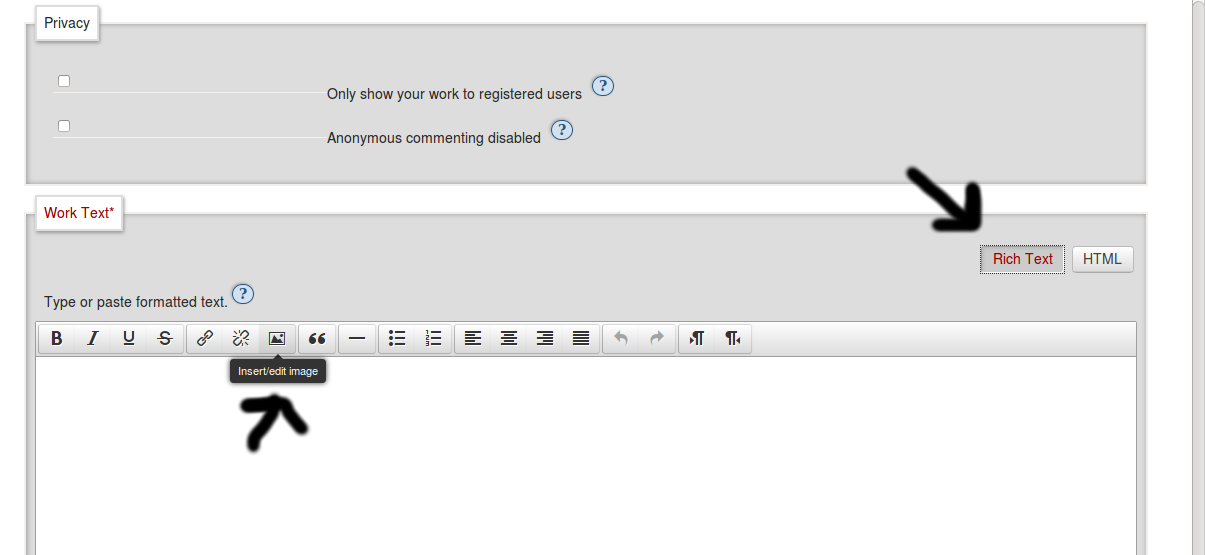
How can images be posted to AO3?
See this image. (Taken from Night on Fic Mountain.)
How can creators access collection event works prior to work approvals/reveals?
Since submissions in an event collection prior to work reveals are not yet public, creators may want to review their work. Unrevealed works can be accessed through a user's Assignments or Statistics page.
As long as a user has listed an unrevealed collection in New/Edit Work (Associations > "Post to Collections / Challenges"), it will not be public or show up on their profile when they hit "Submit."
Can creators reply to work comments during the anonymous round?
Yes. If your event has an anonymous round, creators who comment/reply on their own work will show up anonymously. Comments will automatically be de-anoned when creators are revealed.
How should I deal with bans/dropouts?
This is entirely subjective, but ultimately I would say to not issue an explicit ban-rule if you are unsure about running the event again. This way, if you do, you can deal with problem participants on a case-by-case basis (if they sign up again) instead of needing to stick by your own words.
Ban rules are only a concern across multiple iterations of a challenge, or kinkmemes.
Behavior that may constitute a ban may be:
- Last-minute dropout on an assignment (temporary ban)
- Deliberate rudeness and poor etiquette
- Post-event work deletion
- Exchange signup and then immediate dropout
- Submission rule-breaking, such as submitting an existing work instead of a brand new one
I advise temporary bans for last-minute dropouts as it serves a reasonable penalty for the inconvenience, but is not excessive in eternally expecting users to repeat the behavior. Deliberate rudeness/poor etiquette, work deletion, exchange signup/immediate dropout, and general submission rule-breaking go against the spirit of fandom events, though whether a temporary or permanent ban is issued is up to you.
I heavily recommend not issuing bans based on social media behavior, as that opens a can of worms to policing participants' social media accounts. However, if you would personally not like to interact with or manage certain fans in an event moderation setting, I can't tell you what to do.
Moderating is not a personal transaction; when I moderate an event, I represent the event as a whole, not myself. In other words, moderating requires fandom professionalism. Do not let personal biases guide your moderation instincts. However, your social instincts are valuable, as well as your ability to evaluate if a certain participant or interaction is worth your energy.
Due to the nature of fandom, I prefer erring on the side of giving people the benefit of the doubt. People usually would rather participate than break rules just to test your patience. And because fandom events are about encouraging that participation, guidelines that are far more free than limited are more likely to give everyone a positive experience all around, especially yourself as the mod.
Notes on Charity Events
Though fandom is characteristically nonprofit, many people in fandom are generous enough to utilize its enthusiastic gift economy for charitable purposes. Therefore, for charity events, your goal shifts from being community focused to maximizing monetary profit.
In this case, I highly suggest:
- Auctions/Raffles
- Maximizing inclusivity for creators and/or payers
- Looser guidelines regarding due dates, since the focus is more on the payment than the work
Exclusive charity zines depend on buyer interest, which is not always dependable in fandom. This tends to minimize profit, even if any profit is acquired.
Similarly, single-scope zines may limit interest from both participants and buyers. Multi-fandom, mega-fandoms, and popular scopes align better with charity goals because they inherently encourage more buyers. Thus, more profit for the charity in question.
People may also feel scammed if they pay for a zine that never gets delivered or has an unusually long production schedule, especially without a reliable receipt of charity donation. Similarly, if buyers are to present their own receipt of donation in order to acquire your zine, they may scam you unless they are obligated to doxx themselves.
Unless you are responsible with money, publicity, and privacy; and if your goal equally emphasizes zine production or if there is a high interest in event scope, I recommend auctions/raffles for charity events instead.
Because money can be contentious in fandom (and in general), be mindful of financial responsibilities to avoid potential distrust while also maximizing profit.
Glossary
These are additional terms that typically come up in the context of fandom events.
Beta - Shorthand for "beta reader," or someone who copyedits and proofreads a work for polishing.
De-anon - To take a work off anonymity for anonymous rounds, or for users to attribute themselves to an anonymous assignment in public (or "namespace.")
Dear Creator Letter - A letter for signup exchanges, supplementary to requested prompts. Participants may choose to create one to expand on their likes, dislikes, prompts, and general enthusiasm. Dear Creator Letters are often hosted on Dreamwidth/LiveJournal, Tumblr, or Google Docs. You can allow a field for participants to link their letters in AO3 signup forms.
Default - AO3 term for dropping out.
DNW - Do Not Wants in signup requests or offers.
Fill - A work created in response to a prompt or request.
KINKTOMATO - Another way of saying "YKINMKATOK," or, "your kink is not my kink and that's okay." Usually used to indicate no kink-shaming during events or challenges, particularly for kinkmemes.
Mod - Shorthand for "moderate" or "moderator." User(s) overseeing the event. You may be the head mod of a mod team, have a finance mod for a zine, and so on.
Nom - Shorthand for "nominate" or "nomination." See Nominations.
ODAO - "Optional Details are Optional" is the exchange principle that works are only expected to abide by assignment requirements (fandom, ship, medium, rating), and that supplementary material such as prompts or lists are not necessarily required in the final work. However, DNWs still tend to be necessary to follow.
PH - Shorthand for Pinch Hits.
Prompt Meme - Synonymous with Kinkmeme, with less nominal focus on kink.
Recip - Short for "recipient."
Squick - Content turn-offs; synonymous with DNW.
Final Notes
I hope this is a decent rundown of running fandom events. Maybe this will motivate someone to run their own event for the first time. Good luck to all my fellow mods!
If you have any questions about moderating, feel free to let me know :)